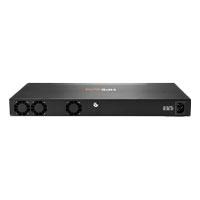
HPE JL728A – Switch Aruba 6200F de 48 g Puertos CL4 y 4SFP740W Administrable Capa 3

Agotado
Especificaciones Extendidas
Descripción
Key Features
Enterprise-Class connectivity with support for ACLs, robust QoS and common protocols such así static and Access OSPF routing scalability with 8 member switch VSF stacking
Scalability with 8-MEMBER switch VSF stacking for up to 384 downlink Ports
Versatile 1 g/10 g uplinks with LRM and MACsec 256 support ON modular switches
Convenient built-in 1 g/10 g uplinks ON Fixed Power switches and additional cost-efficient 1 g uplink switch models
Industry Standard Power over Ethernet with up to 30 W PoE Class 4 per Port ON Fixed Power switches and up to 60 W PoE Class 6 per Port ON modular Power switches
Intelligent Monitoring, Visibility, and troubleshooting with aruba Network Analytics Engine
Manage vía single pane of Glass with aruba central across wired, Wireless, and WAN
Simple, One Touch deployment with the aruba CX Mobile App
Automated Configuration and verificación with aruba netedit
Secure and simple Access for users and IoT with aruba Dynamic segmentation
Especificaciones
Layer 2 Switching
The following Layer 2 Services ARE Supported:
VLAN support and tagging support IEEE 802.1Q 4094 VLAN IDS and 2K VLANs simultaneously
Jumbo Packet support improves the performance of large Data transfers; supports frame size of up to 9198 bytes
IEEE 802.1 V Protocol VLANs isolate Select NON-IPV4 protocols automatically into their Own VLANs
Rapid per-VLAN Spanning Tree RPVST allows each VLAN to build a separate Spanning Tree to improve Link Bandwidth usage; IS compatible with PVST
MVRP allows Automatic learning and Dynamic assignment of VLANs
Vxlan encapsulation tunnelling Protocol for overlay Network that enables a more escalable virtual Network deployment
Bridge Protocol Data Unit BPDU tunnelling transmits STP bpdus transparently, allowing correct Tree calculations across Service providers, wans, or mans
Port mirroring duplicates Port Traffic ingress and egress to a Monitoring Port; supports 4 mirroring groups
STP supports Standard IEEE 802.1D STP, IEEE 802.1 W Rapid Spanning Tree Protocol RSTP for faster convergence, and IEEE 802.1S múltiple Spanning Tree Protocol MSTP
Internet Group Management Protocol IGMP Controls and manages the flooding of multicast packets in a Layer 2 Network
Layer 3 Services
The following Layer 3 Services ARE Supported:
Loopback Interface address defines An address in Open shortest path First OSPF, improving Diagnostic capability
Address Resolution Protocol ARP determines the MAC address of another IP host in the same subnet; supports static arps; gratuitous ARP allows Detection of duplicate IP addresses; proxy ARP allows normal ARP Operation between subnets or when subnets ARE separated by a Layer 2 Network
Domain name System DNS provides a distributed database that translates Domain names and IP addresses, which simplifies Network Design; supports Client and Server
Supports internal loopback testing for maintenance purposes and increased Availability; loopback Detection protects against incorrect cabling or Network configurations and CAN be enabled ON a per-Port or per-VLAN basis for added flexibility
Route maps provide more control during route redistribution; allow filtering and altering of route metrics
Dynamic host Configuration Protocol DHCP simplifies the Management of large IP Networks and supports Client; DHCP relay enables DHCP Operation across subnets
DHCP Server centralizes and reduces the cost of IPv4 address Management
Simplified Configuration and Management
In addition to aruba central, the aruba CX Mobile App, aruba netedit and aruba Network Analytics Engine, the HPE aruba Networking CX 6200 switch series offers the following:
Built-in programable and Easy-to-use rest API Interface
Simple Day Zero Provisioning
SFlow RFC 3176 IS asic-based wire Speed Network Monitoring and accounting with no impact ON Network performance; Network operators CAN gather a variety of Network statistics and information for capacity planning and real-Time Network Monitoring purposes
Management Interface control enables or disables each of the following depending ON Security preferences, Console Port, or reset Button
Industry-Standard CLI with a hierarchical structure for Reduced training Time and expense. Delivers increased productivity in multivendor environments
Management Security restricts Access to critical Configuration commands, provides múltiple privilege levels with password Protection and local and Remote syslog capabilities allow logging of all Access
SNMP V2C/V3 provides SNMP read and trap support of Industry Standard Management information base MIB, and Private extensions
| SNMP support includes | Write set Speed and dúplex, write Port Security, write PoE priority, write Config MGMT, SNMP-read single OID for average CPU and memory, SNMP MIB View |
|---|---|
| SNMP trap include | Transceiver traps inserción/removal, SNMP trap, SNMP MIB-SNMB authentication, SNMPV2 MIB, Port SEC MIB-Port SEC, Config MIB-running Config change, Config MIB, AAA Server MIB, AAA Server State |
Remote Monitoring RMON with Standard SNMP to monitor Essential Network functions. Supports events, alarms, history, and statistics groups así well así a Private Alarm extensión Group; RMON, and sFlow provide Advanced Monitoring and reporting capabilities for statistics, history, alarms and events
TFTP and SFTP support offers different mechanisms for Configuration updates; trivial FTP TFTP allows bidireccional transfers over a TCP/ IP Network; Secure File transfer Protocol SFTP runs over An SSH tunnel to provide additional Security
Debug and sampler Utility supports ping and traceroute for IPv4 and IPv6
Network Time Protocol NTP synchronizes timekeeping among distributed Time servers and clients; keeps timekeeping consistent among all clock-Dependent Devices within the Network
IEEE 802.1AB Link Layer discovery Protocol LLDP advertises and receives Management information from adjacent Devices ON a Network, facilitating Easy mapping by Network Management applications
Dual flash images provides independent primary and Secondary operating System files for Backup while upgrading
Múltiple Configuration files CAN be stored to a flash Image
Ingress and egress Port Monitoring enable more efficient Network problem solving
Unidirectional Link Detection udld monitors the Link between TWO switches and blocks the Ports ON both ends of the Link IF the Link goes down at ANY Point between the TWO Devices
IP SLA for Voice monitors Quality of Voice Traffic using the UDP jitter for VoIP tests
Layer 3 Routing
The following Layer 3 routing Services ARE Supported:
Routing information Protocol versión 2 RIPV2 provides An Easy to configure routing Protocol for Small Networks así while RIPng provides support for Small IPv6 Networks
Single-área Open shortest path First OSPF delivers faster convergence; uses Link-State routing interior gateway Protocol IGP, which supports nssa, and MD5 authentication for increased Security and graceful restart for faster failure Recovery
OSPF provides OSPFV2 for IPv4 routing and OSPFV3 for IPv6 routing
Static IP routing provides manually configured routing
Static IPv4 routing provides simple manually configured IPv4 routing
IP performance Optimization provides a set of Tools to improve the performance of IPv4 Networks; includes directed broadcasts, customization of TCP parameters, support of ICMP error packets, and extensive display capabilities
Static IPv6 routing provides simple manually configured IPv6 routing
Dual IP stack maintains separate stacks for IPv4 and IPv6 to ease the transición from An IPV4-ONLY Network to An IPV6-ONLY Network Design.
MDNS multicast Domain name System gateway enables discovery of MDNS groups across L3 boundaries
Equal-cost multipath ECMP enables múltiple equal-cost links in a routing Environment to increase Link redundancy and scale Bandwidth
Open shortest path First OSPF delivers faster convergence; uses Link-State routing interior gateway Protocol IGP, which supports ECMP, nssa, and MD5 authentication for increased Security and graceful restart for faster failure Recovery
Static IP routing provides manually configured routing; includes ECMP capability
Garantía: Sin garantía
Recursos y Descargas Técnicas
Equipos de la misma línea
-
Oferta −67%
 ¡Última pieza!
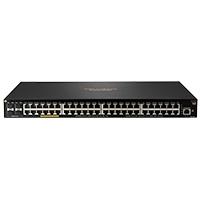
HPE JL557A – Switch HP Aruba 2930F 48 g RJ45 PoE 740 W y 4 SFP 1 g Administrable L3
El precio original era: $192,491.26.$63,834.92El precio actual es: $63,834.92. inc IVA Envío gratis -
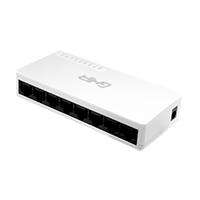
GHIA GNW-S2 – Switch 8 Puertos RJ45 10/100 Mbps No Administrable Auto MDI/MDIX Half Full Dúplex
$160.35 inc IVA -
Oferta −49%
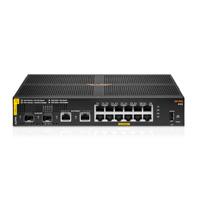
HPE JL679A – Switch Aruba 6100 Administrable Capa 2 12 g Puertos PoE CL4 2SFP 2RJ45 1 g 139WATTS
El precio original era: $31,411.30.$15,952.74El precio actual es: $15,952.74. inc IVA Envío gratis -
Oferta −40%
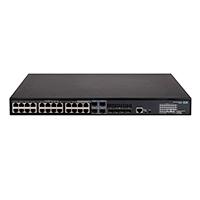
HPE JL827A – Switch Aruba 5140 24 g PoE 4 Combo SFP y 4SFP EI 370 W
El precio original era: $146,908.17.$88,144.90El precio actual es: $88,144.90. inc IVA Envío gratis